Back to newsroom
The Single-Chip Camera Era: Automotive Imaging Is Entering a New Phase
By Ron Sela, Director of Products, Valens Semiconductor September 23, 2026
Automotive cameras have continuously become more capable, but their fundamental design has remained largely unchanged. Higher resolution, longer range, improved low-light performance, and increasingly intelligent sensing have expanded what vehicles can perceive.
The next breakthrough, however, may have less to do with what cameras can see and more to do with how they are built.
A new generation of image sensors with built-in MIPI A-PHY connectivity is beginning to change automotive camera design, enabling a move from the conventional image-sensor-plus-serializer approach toward a single-chip camera design.
This is no longer only a future vision. Leading industry players have already begun embracing this approach, with Sony introducing the industry’s first automotive image sensor with a built-in MIPI A-PHY interface. This milestone provides an early example of how camera design could evolve as the number of cameras in vehicles continues to grow.
The Pressure to Do More with Less
The rapid growth of camera-based applications is one of the defining trends in automotive technology. Advanced Driver Assistance Systems (ADAS), Driver Monitoring Systems (DMS), electronic mirrors, surround-view applications, and automated driving platforms all rely on an expanding network of imaging sensors distributed throughout the vehicle.
As camera-based functions continue to expand, some vehicle platforms are moving toward double-digit camera counts, with future architectures expected to become even more sensor-intensive. For OEMs and Tier-1 suppliers, this creates a significant challenge. More cameras enable more functionality, but they also increase system cost and integration complexity.
Until now, automotive cameras have followed a relatively consistent design approach. Inside the camera module, an image sensor captures visual information and converts it into digital data, which is then passed to a dedicated serializer before being transmitted to the vehicle’s remote processing systems.
The image sensor-plus-serializer design is well established and widely deployed across the automotive market. However, it requires at least two primary active devices inside each camera module: the image sensor and a separate serializer. Each device occupies PCB space and requires its own supporting components, adding to the camera module’s bill of materials and design complexity.
When this design is repeated across a growing number of cameras these additional components can have a meaningful impact on overall system cost and complexity. This creates a clear opportunity to simplify the camera module by integrating functions that previously required separate devices.
Integrating A-PHY into the Image Sensor
The introduction of MIPI A-PHY marked an important development for automotive connectivity. Designed specifically for high-speed, long-reach sensor and display connectivity within the car, A-PHY provides a standardized physical-layer interface for the growing demands of automotive imaging.
Unlike proprietary automotive connectivity technologies, MIPI A-PHY provides a standardized long-reach connectivity interface designed for automotive cameras and other sensors. Its standardized approach supports an open ecosystem and creates the foundation for integrating long-reach connectivity directly into the image sensor.
This standardized approach allows image sensor manufacturers to integrate A-PHY transmission capabilities directly into the image sensor. Functions that previously required an image sensor together with a separate serializer can now be combined in a single device, enabling a fundamentally simpler camera design.
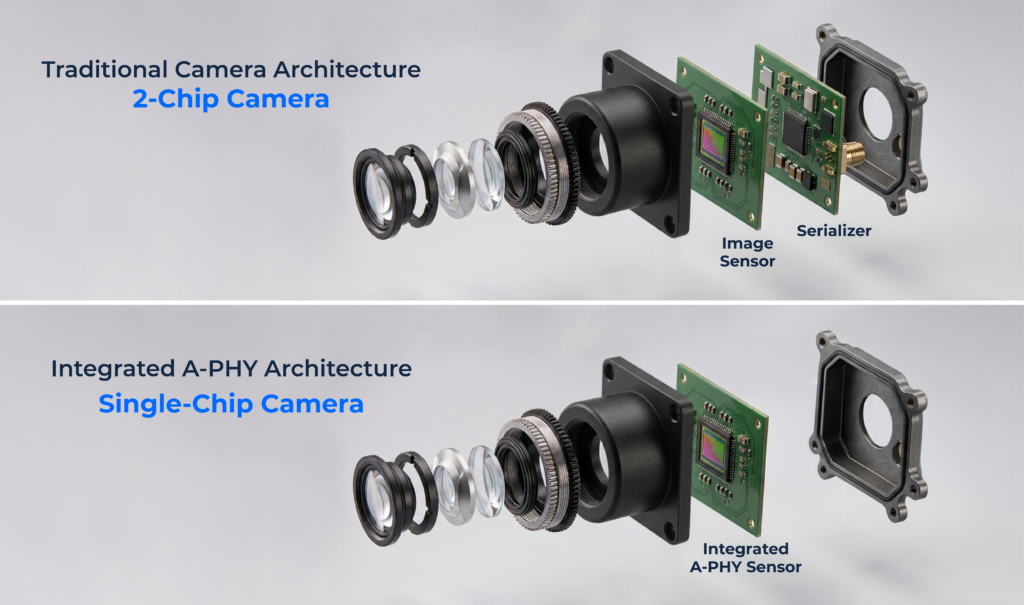
By eliminating the need for a standalone serializer, integrated A-PHY image sensors enable a transition from the traditional two-chip design to a streamlined single-chip camera design. This represents an important evolution in camera technology, creating a simpler and more cost-efficient approach to building automotive cameras.
Key Advantages:
· Lower Camera Cost: By eliminating the need for a standalone serializer, manufacturers can reduce component count and simplify camera design. The savings extend beyond the serializer device itself, reducing the associated supporting components and overall bill of materials.
· Lower Power Consumption and Reduced Thermal Load: With A-PHY functionality integrated into the image sensor, the camera module can operate with fewer active components, helping reducing its power consumption. Lower power also means less heat generation, which can reduce thermal load within the camera module.
· Smaller Camera Modules: Integrating A-PHY functionality directly into the image sensor enables more compact camera designs. Smaller camera modules give OEMs greater flexibility in camera placement and makes it easier to meet different vehicle packaging requirements.
The Transition Is Already Underway
What makes this development particularly significant is that it is no longer theoretical. The transition toward single-chip cameras has already begun.
A major milestone was reached with the introduction of Sony’s IMX828, the industry’s first automotive 8-megapixel image sensor with a built-in MIPI A-PHY interface. This product demonstrates that integrated A-PHY sensors have successfully moved beyond the concept stage and into commercial reality.
The significance extends beyond a single product. It provides an early example of a broader shift in automotive camera design, where functions that previously required separate devices can increasingly be integrated into the image sensor itself.
Recent developments across the ecosystem further validate this trend. Valens Semiconductor and onsemi have announced plans to collaborate on a cost-optimized image sensor with built-in MIPI A-PHY connectivity, underscoring the industry’s shift toward simpler and more cost-efficient camera designs.
For image sensor manufacturers, Tier-1 suppliers, and OEMs alike, the message is becoming increasingly clear: the future of automotive imaging will not be defined solely by better sensors, but by more cost-efficient cameras.
The Single-Chip Camera Era Is Beginning
The automotive industry is entering a period of continued growth in camera-based sensing. As camera counts continue to climb, reducing the cost and complexity of each camera will become increasingly important.
Integrated A-PHY sensors offer a compelling path forward, combining high-speed connectivity with a dramatically simplified camera design.
The first products are already here. The momentum is building. And the direction of the market is becoming increasingly clear.
The future of automotive imaging isn’t just about higher resolution or more cameras. It’s about delivering the required sensing capabilities at a lower system cost. And the single-chip camera era is beginning.