


 Back to newsroom
Safer Vehicles, Smarter Architectures: The Impact of New Safety Regulations on Automotive Design
By Daniel Shwartzberg, Director of Business Development, Automotive, Valens Semiconductor August 3, 2026
Not long ago, advanced driver assistance systems (ADAS) were considered premium features reserved for luxury vehicles. Automatic emergency braking, driver monitoring, lane keeping assistance, and pedestrian detection were viewed as differentiators, capabilities designed to enhance the driving experience and help automakers stand out in a competitive market.
Today, safety technologies that once set premium vehicles apart are rapidly becoming industry expectations. Around the world, regulators are increasingly treating these technologies not as optional features, but as essential safety requirements. From Europe and North America to China and emerging automotive markets such as India, governments are introducing new regulations and safety frameworks that require automakers to deploy increasingly sophisticated safety systems.
For automakers, the challenge extends well beyond compliance. As safety requirements expand, vehicle architectures must evolve to support a growing number of sensors, cameras, and compute platforms.
A Global Shift Toward Safer Vehicles
The push toward advanced vehicle safety is not limited to a single region.
In Europe, the EU’s General Safety Regulation (GSR) expanded in July 2024, requiring technologies such as automated emergency braking, lane keeping assistance, driver drowsiness detection, and intelligent speed assistance on all newly sold vehicles. According to the European Commission, these measures are expected to help save more than 25,000 lives and prevent at least 140,000 serious injuries by 2038[1]. Additional requirements for driver distraction monitoring systems are applying to newly registered vehicles from July 2026[2].
The United States is moving in a similar direction. In 2024, NHTSA finalized a rule requiring Automatic Emergency Braking (AEB), including pedestrian detection capabilities, on all passenger vehicles by 2029. The agency estimates the regulation will save at least 360 lives and prevent approximately 24,000 injuries every year once fully implemented[3].
Emerging automotive markets are embracing similar safety priorities. India has proposed phased ADAS requirements for commercial vehicles beginning in 2026, including AEBS, Driver Drowsiness and Attention Warning Systems, Lane Departure Warning Systems, and Blind Spot Information Systems[4]. Meanwhile, China has tightened oversight of assisted-driving technologies following several high-profile accidents, placing greater emphasis on driver engagement, supervision, and the responsible deployment of intelligent driving features[5].
While the regulatory details differ between regions, the overall direction is consistent: more safety systems, more sensing capabilities, and greater expectations for vehicle intelligence.

The Architectural Challenge Behind Safer Vehicles
Delivering these new safety capabilities requires far more than software alone.
Many of these functions rely on additional sensing, processing, and data flows throughout the vehicle. Driver monitoring systems often depend on in-cabin cameras, while automated emergency braking systems typically rely on inputs from sensors such as cameras and radar. Pedestrian protection, blind spot detection, and surround-view functions can further increase the amount of sensor data that must be transmitted and processed throughout the vehicle.
As vehicles add more sensing capabilities, the challenge is no longer limited to collecting information. It is about reliably transporting that information to centralized processing platforms where safety decisions can be made in real time.
The automotive industry is increasingly moving toward centralized and software-defined vehicle architectures, where data from multiple sensors is aggregated and processed by powerful domain controllers or central compute platforms. In these architectures, connectivity is no longer just a supporting function. It becomes a critical enabler of vehicle safety. The connection between a sensor and the processing system must deliver high bandwidth, low latency, long reach, and exceptional electromagnetic compatibility (EMC) performance.
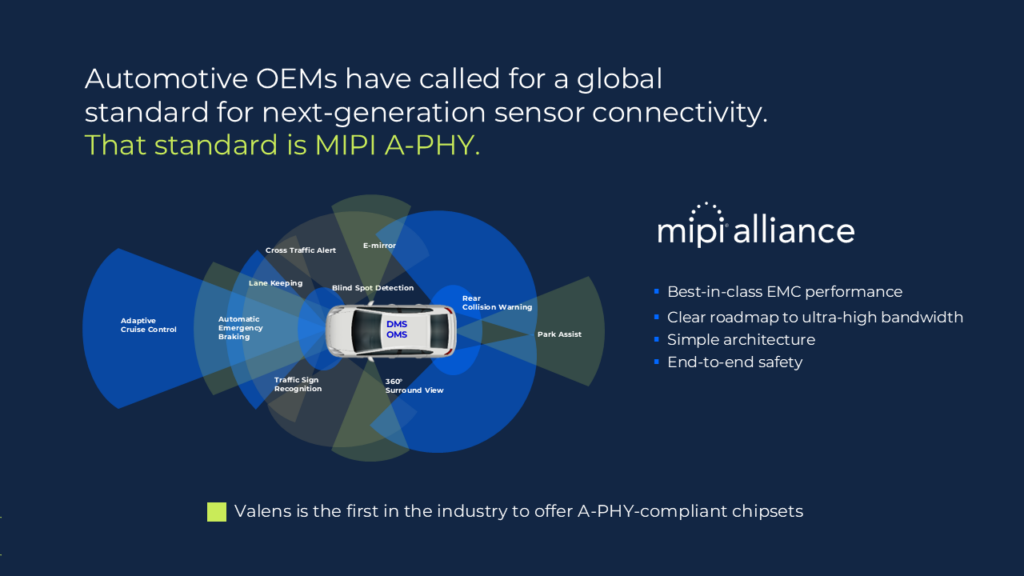
MIPI A-PHY: Why Standardization Matters
The growing complexity of vehicle architectures is creating a preference for standardized, interoperable connectivity solutions that can support long product lifecycles, multi-vendor ecosystems, and future scalability.
This is one of the key reasons the automotive industry is increasingly embracing MIPI A-PHY, as it offers several important advantages:
- An Open Standard: MIPI A-PHY enables silicon-level interoperability across a growing ecosystem of suppliers, giving OEMs greater sourcing flexibility and helping reduce vendor lock-in risks.
- A Mature Ecosystem: Supported by a growing ecosystem of automotive suppliers, A-PHY provides a validated and production-ready foundation for next-generation sensor and display connectivity.
- Purpose-Built for Automotive: Designed specifically for the automotive environment, A-PHY combines multi-gigabit bandwidth with exceptional EMC performance, helping ensure reliable data transmission even under challenging operating conditions.
As advanced safety systems become more widespread, these characteristics become increasingly important for automakers looking to balance performance, scalability, cost, and long-term platform flexibility.
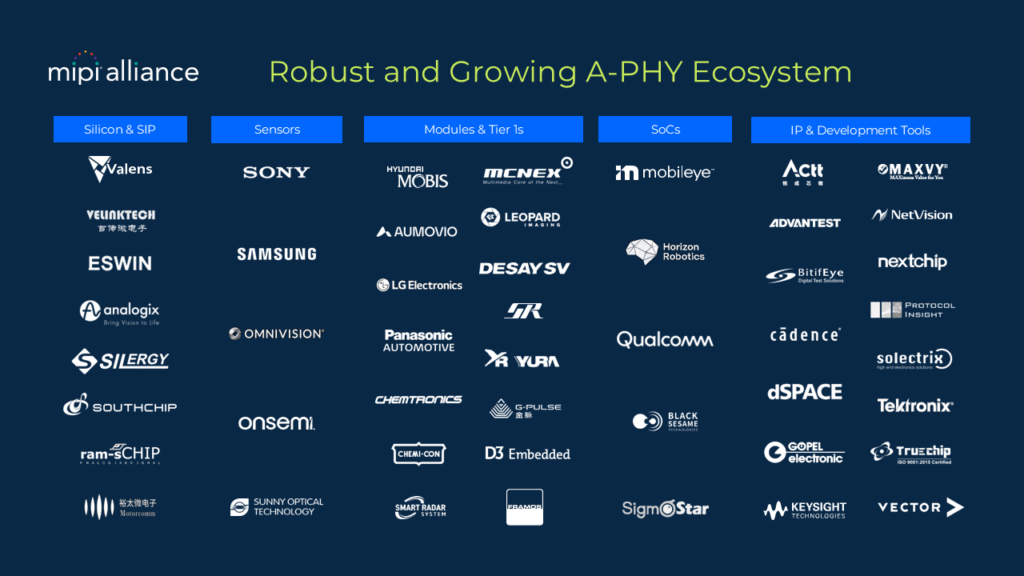
Valens’ VA7000: Enabling the Next Generation of Vehicle Safety
The global momentum behind vehicle safety regulation shows no signs of slowing down.
Whether driven by legislation, consumer demand, safety-rating programs, or all three, automakers around the world are being pushed toward deploying more sophisticated ADAS capabilities across a broader range of vehicle segments.
The visible outcome will be safer vehicles. The less visible, but equally important, outcome will be the continued evolution of vehicle architectures designed to support those systems.
Valens’ VA7000 chipset family, compliant with the MIPI A-PHY standard, was designed specifically to support this transformation. By enabling robust multi-gigabit sensor connectivity with industry-leading EMC performance, VA7000 helps automakers and Tier-1 suppliers build scalable architectures capable of supporting the growing number of cameras, sensors, and compute platforms found in modern vehicles.
Safety regulations may define the capabilities vehicles must provide, but connectivity plays a critical role in making those capabilities possible. As sensors, compute, and data volumes continue to grow, robust and standardized connectivity will become an increasingly important foundation for the next generation of safer vehicles.






[1] Source: https://single-market-economy.ec.europa.eu/news/mandatory-drivers-assistance-systems-expected-help-save-over-25000-lives-2038-2024-07-05_en
[2] Source: https://www.roadandtrack.com/news/a71867596/european-union-mandate-driver-attention-monitoring/
[3] Source: https://www.nhtsa.gov/press-releases/nhtsa-fmvss-127-automatic-emergency-braking-reduce-crashes
[4] Source: https://www.motorindiaonline.in/govt-moves-to-mandate-adas-aebs-stability-systems-for-cvs/
[5] Source: https://apcoworldwide.com/blog/road-safety-china-tightens-regulations-on-intelligent-driving/