Back to newsroom
From Modular Setups to Embedded Systems: Integrating Extension into Video Conferencing Peripherals
By Eli Ofek, VP of Business Development, Valens Semiconductor May 28, 2026
The modern conference room has evolved rapidly, yet the hardware behind it is often still playing catch-up. For years, the industry standard for video conferencing has relied on a fragmented setup of external peripherals. To connect between cameras, laptops, and displays, integrators have had to rely on a complex web of external extenders, converters, and power supplies. While effective, this fragmented setup introduces multiple points of failure and significant installation overhead.
The industry is now reaching a tipping point. The demand is shifting away from external peripherals toward embedded connectivity. Users, manufacturers and integrators alike are looking for streamlined, “all-in-one” devices where robust, long-reach connectivity is built directly into the product itself. As a leading architect of high-performance connectivity standards, Valens is uniquely positioned to drive this shift from the inside out – or in this case, from the outside-in.
Projecting the Future: Learning from the Projector Revolution
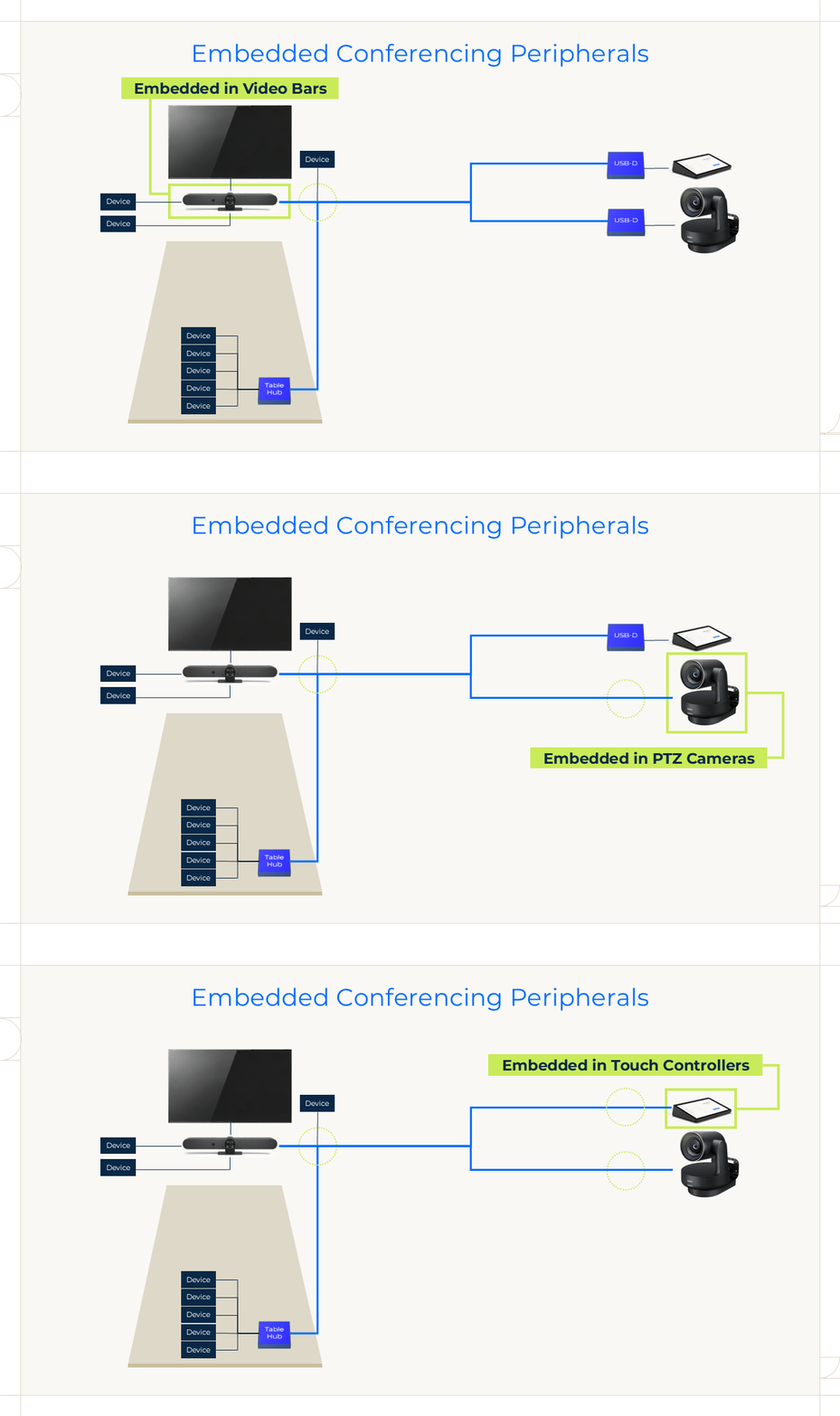
This isn’t the first time Valens has led a transformation of this scale. We’ve successfully played this role before in the ProAV projection market. Not long ago, connecting a high-end projector required a separate receiver box strapped to the ceiling just to overcome the distance limitations of standard cabling. Valens changed that by working directly with leading manufacturers such as Epson, NEC, Panasonic and Sony to embed HDBaseT technology into the chassis.This move didn’t just simplify the architecture, it established a new industry standard for projector connectivity and also lowered the cost of the solution. Today, we are seeing that same evolution sweep across the entire video conferencing spectrum. From soundbars and PTZ cameras to touch controllers, a clear trend is emerging: a decisive shift toward embedded video conferencing applications.
The Embedded Advantage: Why It Matters
By integrating Valens’ chipsets – such as the VS3000, VA6000, or VS6320 – directly into video conferencing hardware, we are tackling some of the most persistent pain points in ProAV deployment:
- Uncompromised High Performance: At the core of Valens’ technology is the ability to deliver unparalleled extension capabilities without sacrificing quality. By embedding our chipsets directly into devices, manufacturers can enable uncompressed, high-bandwidth video and audio transmission with zero latency, while ensuring exceptional resilience to electromagnetic interference (EMI) and rock-solid link stability. The result is a premium, lower cost, more robust, seamless user experience that external, multi-device setups simply cannot match.
- Simplified installation: With embedded connectivity, it’s not just fewer cables – it’s fewer devices. By eliminating the need for external TX/RX pairs, we remove the clutter. There are no extra boxes to mount behind displays or under tables, and no need for the additional patch cables that connect them. It is true plug-and-play at the architectural level. The result is a dramatically simpler installation process, saving both time and effort.
- Cost reduction: The shift to embedded solutions drives down costs in several ways:
Hardware savings: Fewer external components required optimizing manufacturers’ costs.
Installation savings: When there is less hardware to install and fewer components to configure, the entire installation becomes more profitable.
Maintenance savings: fewer elements to manage and replace also reducing cost. - Increased reliability and robustness: As every physical junction is a potential point of failure, by reducing the number of external connections, embedded solutions inherently become more robust and reliable. Fewer cables, fewer interfaces, and fewer dependencies translate directly into improved system uptime and performance.
- Streamlined management & maintenance: When everything is built into a single device, system management becomes more intuitive.There’s no need to coordinate between multiple external units or troubleshoot across different components. Updates, control, and monitoring can all be handled more efficiently – making life easier for both IT teams and end users.
Enabling the Next Generation of Video Conferencing
As the demand for high-quality, flexible collaboration continues to grow, so does the need for smarter, more efficient system design. The transition to embedded video conferencing applications represents a fundamental shift in how collaboration systems are designed and deployed, enabling use cases with multiple cameras and touch consoles while dramatically simplifying installation and reducing costs. As the industry continues moving toward integrated architectures, solutions that combine high performance with simplicity will lead the way.
Valens’ connectivity technology is at the heart of this transformation – delivering the high-speed, long-reach, and interference-resilient performance required for modern video conferencing, while enabling seamless integration into embedded platforms.
From cameras and video bars to displays and compute devices, Valens solutions empower manufacturers to design systems that are not only powerful – but also simpler, more efficient, and future-ready – bringing the next generation of embedded connectivity to life.