

Classroom projectors were built around the interfaces of the PC era: first VGA, then HDMI. Those interfaces continue to do their core job well – getting an image from the teacher’s computer to the projector.
But the device on the teacher’s desk has changed. USB-C is now a standard connection across modern laptops, while classrooms themselves are becoming more interactive and increasingly connected.
This creates an opportunity to rethink how the teacher’s laptop connects not only to the projector, but to the classroom around it.
Mainstream education projectors remain largely centered on HDMI, with VGA still present in some legacy installations. The architecture is familiar, inexpensive and effective: connect the teacher’s computer and put an image on the screen.
However, four limitations of this classroom infrastructure are becoming increasingly relevant:
USB-C is now firmly established across the laptop categories teachers are likely to use.
Apple’s current MacBook line uses USB-C for data, display and charging. The same pattern is common across mainstream Windows business laptops from vendors such as HP, Dell, Lenovo and Microsoft, where USB-C is used for docking, display output, data and power. USB-C is also established in education-focused devices, including modern Chromebooks.
HDMI has not disappeared – many Windows and Chromebook models still include it – but USB-C has become the common multifunction interface through which laptops connect to displays, docks, power and peripherals. That matters in the classroom because the interface teachers increasingly bring with them is no longer necessarily the interface around which the installed projector system was designed.
Projector manufacturers are beginning to respond by adding USB-C alongside the HDMI inputs, for example, BenQ’s EH700. Behind closed doors, Valens is seeing a growing number of USB-C-based projector platforms under development, including products aimed at education.
USB-C may be changing the connection at the teacher’s laptop, but the physical challenge of an installed classroom remains.
At the higher end of the projector market, the AV industry has already shown how valuable it is to solve that problem inside the projector.
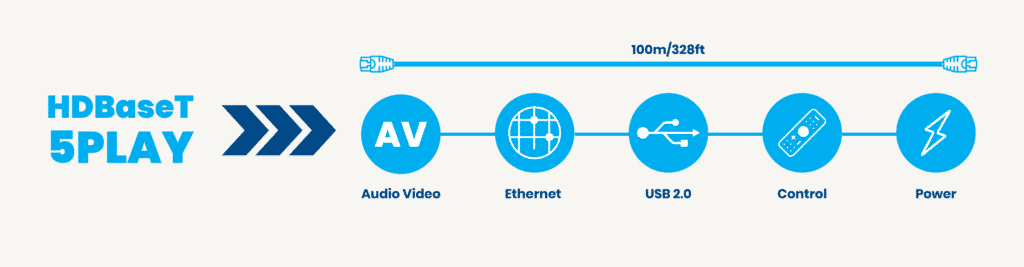
HDBaseT enables video, audio, control, Ethernet and, in appropriate implementations, USB 2.0 to travel over standard Category cabling across long distances. In professional and installation projectors, that has made it possible to replace separate long-distance connections with a single, structured cabling infrastructure.
As a result, HDBaseT has become well established in higher-end projectors. Major projector manufacturers offer HDBaseT-equipped models, particularly in products designed for professional installation, large venues and other applications where long-distance connectivity is a core requirement.
HDBaseT is well suited to premium installation projectors, where its capabilities justify the added system cost. In the lower-end education market, however, cost sensitivity has limited adoption. As a result, many mainstream education projectors still rely on HDMI or VGA for the primary video connection, while any required long-distance extension is handled externally.
There is also a second limitation as classrooms evolve. Conventional HDBaseT can support USB 2.0 functions such as touch, pen input and control, but it does not provide the USB 3 bandwidth required by devices such as high-quality classroom cameras.
So while HDBaseT established the value of bringing long-distance connectivity into the projector, mainstream education now presents a different challenge: how to deliver that same installation simplicity at a cost and power point suited to classroom projectors, while also supporting the higher-bandwidth USB devices entering the room.
That creates an opportunity for a different architecture: extend the USB connection itself.
In an HDBaseT-USB3 architecture, the teacher connects the laptop by USB-C to a mini extender or an active adaptor/extender. From there, USB traffic is extended over standard Category cable to the projector, containing an embedded HDBaseT-USB3 chip.
Projector video can be converted to UVC before entering the USB link, allowing it to travel together with touch, pen and other USB traffic.
The result is a common long-distance USB infrastructure that preserves video and interactivity while adding support for high-bandwidth classroom devices such as cameras.


Bringing the classroom onto a single USB-centric connection changes more than the cable. It changes how many separate systems the room has to carry.
The three approaches can be summarized simply:
| HDMI | HDBT | HDBaseT-USB3 | |
|---|---|---|---|
| Long distance | |||
| High-quality video | * | ||
| Field-terminable cabling | |||
| USB 2.0 | |||
| USB 3.0 | |||
| Controls | |||
| Cost |
* Can achieve 4K60 with light compression
There is another architectural advantage: the projector itself can become simpler.
Today, projector designs may include several source interfaces to cover different use cases – HDMI or VGA for local connections, USB-C on newer models, and RJ45 for longer-distance installations.
A USB-centric architecture creates the opportunity to consolidate these around a single USB-C source interface. For short-distance connections, the projector can use a regular USB-C cable. For longer runs, that same USB-C port can connect either through a pigtail adaptor-extender to Category cable, or through a long HDBaseT-enabled USB-C cable.
The result is fewer connector types, a simpler I/O panel, and a more consistent projector design across different installation scenarios.


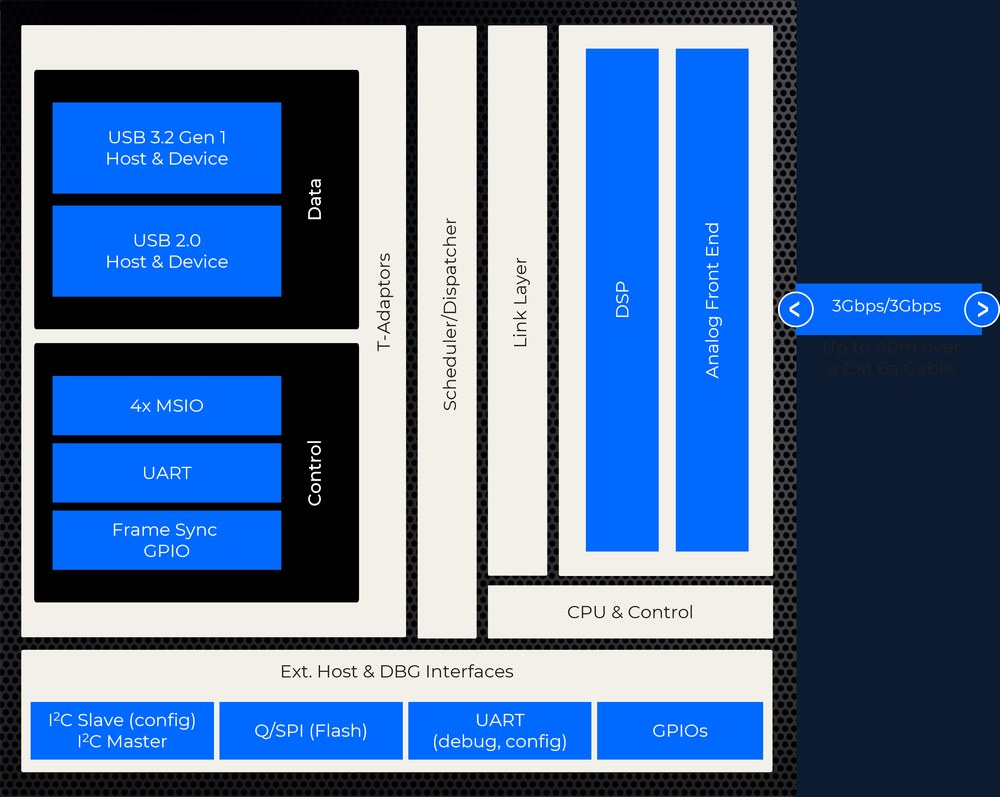
The Valens VS6310 and VS6320 provide two operating points for implementing HDBaseT-USB3 in education systems.
Both extend USB 3 together with USB 2 over standard Category cabling. Manufacturers can choose between them according to the bandwidth, distance, power, size and cost requirements of the product.
The VS6310 is designed for embedded applications where power, size and cost are important.
For mainstream classroom environments, that combination provides enough reach for typical installed runs without designing around a 100-meter requirement.
The available USB 3 bandwidth can support the presentation video after capture and processing, while retaining capacity for classroom USB traffic.
Its lower-power, embedded-oriented design also allows the extension function to move directly into products such as the projector, wall controller or compact adapter.
The VS6320 provides the higher-performance option.
The additional bandwidth provides more headroom when multiple high-bandwidth streams need to coexist – for example, presentation content moving toward the projector while a classroom camera sends video back toward the teacher’s laptop.
It also provides additional capacity for multi-camera systems and larger installations.
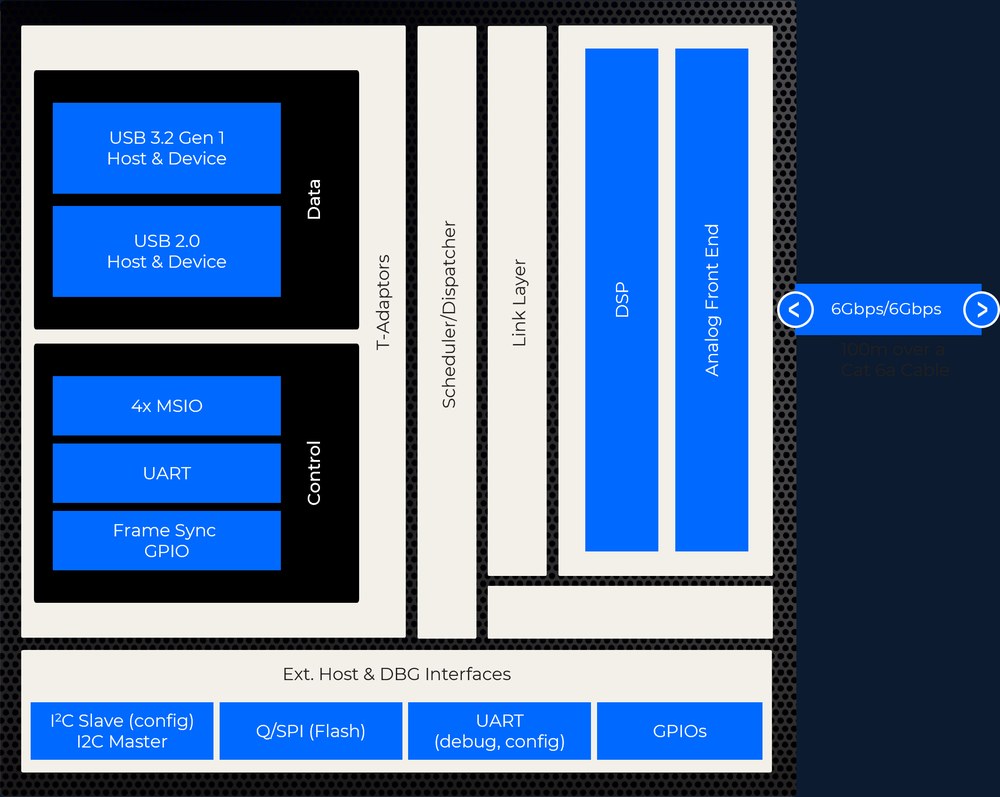
The VS6310 and VS6320 are interoperable, allowing manufacturers to right-size different endpoints while remaining within the same technology ecosystem.
The architecture does not require every school to deploy a complete hybrid classroom from the beginning.
The same connectivity foundation can be introduced in stages, with additional functions added as classroom requirements evolve.
VGA and HDMI defined earlier generations of classroom projection. Today, the teacher’s device has moved to USB-C — now standard across MacBooks, Windows laptops, Chromebooks and education PCs.
The challenge is distance. In installed classrooms, the teacher and projector may be separated by far more than native USB-C was designed to support.
Long-distance USB 3 extension changes that. By extending USB 3 and USB 2 over Category cable, projector manufacturers can bring the USB-C experience across the room — supporting presentation video, touch, cameras and other USB peripherals over the same infrastructure.
What starts as a simple laptop-to-projector connection can evolve into a complete interactive and hybrid classroom platform.
The opportunity is bigger than adding USB-C. It is about making USB-C the foundation of the connected classroom.

A seasoned high-tech executive with over 25 years of experience leading global product, business, and technology initiatives. Eli is recognized for driving innovation with demonstrated success managing full product lifecycles across Professional AV, IoT, Bluetooth/WiFi, and consumer electronics. He holds a B.Sc. in Electrical Engineering from Tel Aviv University and an MBA from Heriot-Watt University.